Big-firm case preparation.
Built for law firms of any size.

Apexfirm builds Caseboard, legal AI that maps evidence against case-type requirements to identify legal issues and gaps in proof before strategy and drafting begin.

Explore Caseboard

Large firms prepare cases with teams. Everyone else prepares alone.

Before a lawyer argues a case, someone has to prepare it: read every piece of evidence, work out which legal issues the case turns on, establish what must be proved, and find where the proof is missing. Most cases are won or lost here.

Large firms assign this work to teams of junior lawyers. Everyone else does it alone. In every legal market, the quality of preparation depends on the size of the firm, not the skill of the lawyer.

Legal AI arrived at writing. Preparation still has no AI.

Legal AI has become one of the fastest-growing categories in business software, and almost all of it helps lawyers research and write. That is the writing stage. The preparation stage has no AI of its own. Some tools organize facts into timelines, and a few suggest issues from the evidence, but none checks the evidence against what that type of case has to prove. A firm with more cases than it can handle has had one option, hiring, and smaller firms often cannot afford even that. Apexfirm built Caseboard for the preparation stage.

What Caseboard does

When attorneys upload evidence, Caseboard maps it against the requirements of the case type to identify legal issues and gaps in proof. Facts are organized by date, person and action and linked to the issues they support, so the lawyer can see which issues have evidence and which need further support before drafting. Strategy and drafting remain with the lawyer.

Firms using Caseboard take on more cases, and a wider range of them, without hiring. For a firm, the right comparison is not other software but the cost of a support team.
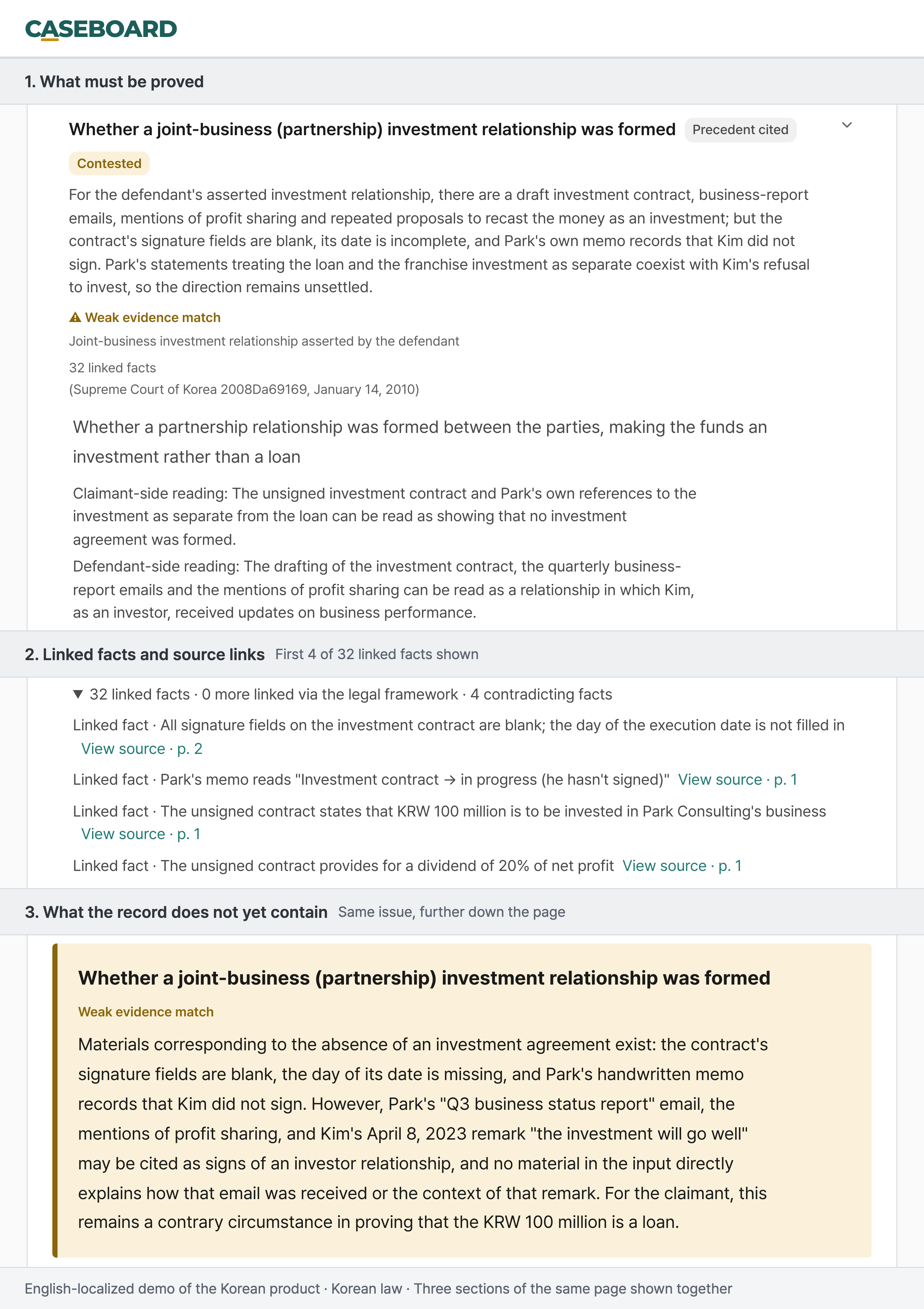
Caseboard demo of a Korean loan dispute showing what must be proved, claimant-side and defendant-side readings, linked facts with source-page references, and missing evidence or explanation
A demo Korean loan dispute: what must be proved, each side's reading of the record, linked facts and source-page references, and missing evidence or explanation. English-localized demonstration of the Korean product under Korean law. Three sections of the same page are shown together; 4 of 32 linked facts are shown. Click or tap the image to enlarge.

What Caseboard does not do

Caseboard does not decide strategy or write legal documents. Strategy and drafting remain with the lawyer. It can be used alongside existing writing tools without additional training.

Explore Caseboard

Why Caseboard can prepare a case and other tools cannot

Case Intelligence is Apexfirm's proprietary framework of what each case type requires: which facts matter, what must be established and what the other side is likely to argue. The framework exists before a lawyer uploads a case. By mapping evidence against those requirements, Caseboard shows the legal issues, their evidentiary support and gaps, and potential opposing arguments. Lawyers can examine the case through its issue structure before deciding how to argue it. Tools that organize evidence do not have this framework. That is the difference. Case Intelligence is patent-pending.

Never a guess

Caseboard never fills a gap with a guess. Every result is traced to the evidence it came from, and where there is no evidence, Caseboard says so. In a profession where lawyers have been sanctioned by courts for citing cases an AI invented, this is the rule the product is built on.

One platform, adapted to each jurisdiction

Case Intelligence runs on a single platform and expands one country or state at a time. The method stays the same; the framework is built for each jurisdiction's law. Caseboard launched in South Korea in 2026, where it is being proven at scale. Taiwan and the United States are next.

A decade of building together

Hyeokin Ro and Seongmin Kim have worked together for more than a decade. They co-founded AVARA and built it into Korea's largest vehicle transport platform. Bemycar Co., Ltd. acquired AVARA in 2020, and it remains the market leader. At Apexfirm, they apply the same approach: identify structural problems an industry has come to accept and build the infrastructure to solve them with technology.


Hyeokin Ro, co-founder and CEO of Apexfirm Hyeokin Ro
CEO · Business Strategy & Product
Yonsei University · LG U+
Seongmin Kim, co-founder and CTO of Apexfirm Seongmin Kim
CTO · AI & Engineering
LG Electronics · LG U+

Frequently Asked Questions

What is Caseboard?

Caseboard is legal AI for litigation case preparation. When attorneys upload evidence, Caseboard maps it against the requirements of the case type to identify legal issues and gaps in proof. Facts and source evidence are linked to the issues they support, so lawyers can see what is supported and what needs further proof before drafting. Strategy and drafting remain with the lawyer.

How is Caseboard different from ChatGPT or Claude?

General-purpose models read legal text well, but they do not know what a given type of case requires. They produce a different structure every time, cannot say what is missing, and agree with whatever they are asked. Caseboard checks every case against Case Intelligence, a framework of what each type of case requires that exists before the evidence is uploaded, so the preparation is consistent, the gaps are visible, and every result is traced to the evidence.

How is Caseboard different from tools that organize evidence?

Tools that build timelines, or suggest issues from the evidence, organize evidence one case at a time. Caseboard prepares the case against a standard that exists before the case arrives: Case Intelligence, the framework of what each type of case requires. It checks the evidence against that standard, shows what is missing, and shows what the other side is likely to argue. Organizing tools do not have the standard, so they cannot tell you what is missing.

How is Caseboard different from AI drafting tools?

Drafting tools help lawyers write. Caseboard does the work before writing: it prepares the case and shows what is missing, so the lawyer decides strategy with the full picture. The two are different products, and lawyers use both.

What is Case Intelligence?

Case Intelligence is Apexfirm's proprietary framework of what each case type requires: which facts matter, what must be established, and what the other side is likely to argue. The framework exists before evidence is uploaded. Caseboard maps the evidence against it to show legal issues, evidentiary support, gaps in proof, and potential opposing arguments. It is patent-pending.

Which markets does Apexfirm operate in?

Case Intelligence runs on a single platform and expands one country or state at a time. The method stays the same; the framework is built for each jurisdiction's law. Caseboard launched in South Korea in 2026, where it is being proven at scale. Taiwan and the United States are next.

Who founded Apexfirm?

Hyeokin Ro, CEO and co-founder, is a serial entrepreneur who has spent more than a decade solving structural business problems through technology. He began his career at LG U+, co-founded AVARA, and later led the digital and AI transformation of enterprise mobility as Chief Strategy Officer at A1mobilsoft before co-founding Apexfirm in 2026. AVARA was acquired by Bemycar Co., Ltd. in 2020 and remains the market leader.

Caseboard demo: enlarged image

Scroll to read the enlarged image. Press Escape or select Close to return.

Enlarged Caseboard demo of a Korean loan dispute: proof requirements, both sides' readings, linked facts with source-page references, and gaps in evidence or explanation